This step-by-step guide should provide you with all the information you need to construct a predictionintervalinExcel. We’ve shown how to set up a table to calculate an upper and lower limit of a predictioninterval given known x and y values.
To illustrate the practical application of this complex formula, we will walk through a detailed example of how to construct a predictioninterval using Microsoft Excel.
In this informative video, we’ll discuss the concept of predictionintervals in the context of regression analysis using Excel. Understanding predictionintervals is essential for anyone...
Creating PredictionIntervals in Excel: To create a predictioninterval in Excel, you would typically fit a regression model to your data and then use the FORECAST function along with the standard error of the regression to calculate the interval.
Understanding how to calculate a 95% predictionintervalinExcel is essential for anyone looking to make informed forecasts based on their data. This statistical tool helps quantify the uncertainty of future observations based on existing data points.
Here we look at any specific value of x, x0, and find an interval around the predicted value ŷ 0 for x0 such that there is a 95% probability that the real value of y (in the population) corresponding to x0 is within this interval (see the graph on the right side of Figure 1). Again, this is not quite accurate, but it will do for now.
Confidence interval can help you figure out the accuracy of the prediction. A smaller interval implies more confidence in the prediction for the specific point. The default level of 95% confidence can be changed using the up or down arrows.
 A simple explanation of how to create a prediction interval in Excel using a step-by-step example.
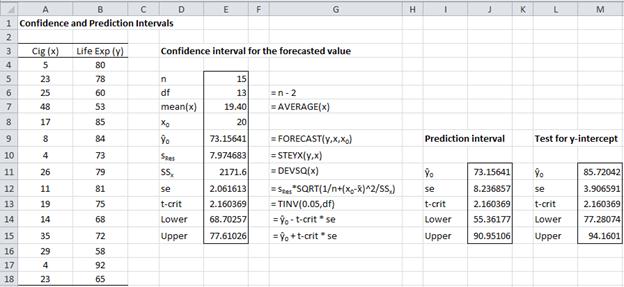 Defines the confidence interval and prediction interval for a simple linear regression and describes how to calculate these values in Excel.